27 September 2019

The settings - they're all wrong!

Senior research officer Edo checked the dials again. The settings were all wrong. 

With mounting panic, he started through the checklist of the Sentient Life Research Protocol for planet Sol972P3 for the third time.

Computer screen with graphs and plotsThe vast array of dials and flickering lights on the control panel didn't change. All the settings were way out. The planet was in deep trouble. And so was he.

Walking along the well-worn corridors of the Academy to see his supervisor, Edo tried to think back to his last review. He couldn't even remember the last time he checked P3. Had he made a mistake with the adjustments back then? Did his hand slip on the dials? Did someone else touch the settings? 

Edo scrolled back through the research review screens, looking for the reason for the mess. The pages of data outputs showed P3 gradually had become more and more unstable under the extreme settings. Dangerous settings. Settings that had probably voided the whole research program, more than likely contravening all sorts of research ethics. 

But it didn't matter really why. It only mattered that it had happened. It was Edo's responsibility to keep on top of the adjustments. Zolic, the program coordinator, would be furious. 

The implications were clear - obvious to any student of Sentient Life Adjustment 101. The settings on P3 had created conditions that were sending the dominant sentient life form to self-destruction.

20 September 2019

Nutrition 2 - the fish tank of neoliberalism

Part 1 of this article explored how food industry bodies influence the advice and information we get about nutrition and healthy eating.

I used the metaphor of a wily octopus for the food industry bodies - bent on its own survival (i.e. profit) and using its many arms infiltrating research, policy, non-government agencies and more to ensure its own interests (again, profit). Misinformation is better for the bottom line of those companies, but an epidemic of diet-related disease is forcing us to sit up and pay attention.

In Part 2, I want to take this metaphor further. 

But before I do, here is yet another book debunking yet another nutrition factoid that justifies a multi-million-dollar industry. Yet again.
photos of octopus inside barrel
Source: Suma Aqualife Park

In a book about omega-3 fish oil supplements, Paul Greenberg describes an industry based on faulty and untested assumptions about human health. No evidence at all actually supports the health claims for omega-3 pills from fish oil. Independent research has found no benefits for heart, brain or mental health. The industry's own research reported 'a non-statistically significant reduction in coronary heart disease risk', which means 'did not find a link.' But nothing has stopped the health claims. Marketing alone fuels the US$15 billion industry, despite no benefit to human health. In fact, the industry is creating vast destruction of the ocean systems from which fish oil, and therefore its ongoing profitability, is extracted.

The octopus will do whatever is necessary to survive, even wreck our health and wreck the natural life systems which sustains it. We need to find another approach besides debunking each dubious claim. 

I need some way to understand this behaviour.

To do so, I look at the broader context - what else is in the metaphorical fish tank with the food industry octopuses.

13 September 2019

Nutrition 1 - getting advice from an octopus?

Where do you get good advice and information about healthy eating, about nutritious food?

Good advice on healthy eating and nutrition??
Very few of us are still cooking and eating like our grandparents. Very few of us learn about nutrition within the food culture of our family, the way it used to be. 

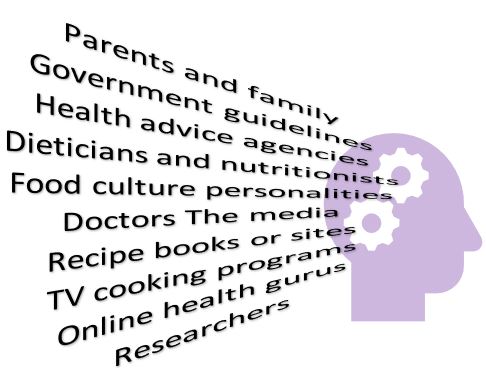
Nutrition advice is everywhere - media articles, friends, celebrity cooks, advertising, government guidelines, online health gurus and more. 

What if I tell you that you are probably really getting your information about healthy eating and nutrition from the food industry bodies... yes, from those corporations set up specifically to maximise profit. 

This article explores the food industry's numerous strategies to maximise profit using the metaphor of an octopus that spreads confusion and clouding ink all over advice about nutrition. Nothing against the amazing octopus; it just has conveniently numerous tentacles and is so flexible that it can get into any space.

As a result, confusion about healthy eating abounds. 

And it's having a seriously bad effect on our health.

6 September 2019

TATKOP 114

There Are Two Kinds Of People: those who are pretty damn sure they are right.

See more in the TATKOP series.


23 August 2019

Better - according to my circle

By guest explorer: Fred Shivvin

The series about the adjective Equal made me think about circular logic. 

I pointed out the argument used by those who set out to oppress others that they are somehow ‘better’ than them, and this justifies both their oppressive actions and their continued status as oppressors.
  
I dominate you because I am better than you because I dominate you
Circular logic (or circular reasoning) is used by people in ‘arguments’ to justify something they believe. 

The 'argument' starts with a point (the premise) that the person assumes is true: in this case 'I am better (superior) than you'. It assumes you already agree that this premise is true, and then no new information is provided to support that premise. You can tell it's circular logic because you can start at either word 'I' in the image and read what seems like a justification. But it's just a circle.

Some circular logic can even sound convincing, but it only convinces people who already agree with the assumed premise. For the rest of us who don’t accept the premise to start with, the argument gives us no reason to change our thinking. 

I don't happen to agree with the premise that any people are 'better' than others, so I don't agree this is the reason that some people dominate others. 

It's not logic at all. It’s a self-reinforcing circle of belief. 


This is why circular 'logic' features so often in 'arguments' about religion.

Circles of justification are extremely common. Spotting a circular argument gives me a sense of accomplishment. They are also sometimes quite alarming. 

16 August 2019

Equal 3 - demand rights or limit power?

In this final part of the Equal series, I ask if demanding equal rights is the best focus for achieving a more egalitarian society and improving the lives of more people.

Part 1 looked back at some famous historical conflicts staged in the name of equality, and the documents celebrated as icons of humanity's moral progress toward a more egalitarian society. It pointed out that those famous conflicts were less about a belief in equality and more about resenting and rebelling against oppression.

Part 2 then explored the history of society to see whether inequality is an inherently 'natural' feature of human beings. It found, instead, that inequality was a trade-off for the more efficient resource production of agrarian society. Western* society developed from an egalitarian society through agriculture and an industrialised society that was increasingly hierarchical, with an unfortunate dearth of social controls over the behaviour of leaders, other than outright revolt. 

Who could have a problem with this?
The structure of Western society has become less rigid over the last 100 years, and more people have equal voting, economic and legal rights. Appeals to 'nature' have not prevailed in support of the argument for denying any person equal rights before the law and equal opportunity.

However, one group of people find this all very distasteful.

This third and final part of the Equal series explores the growing influence of this group, the alarming future they represent, and discusses what can be done about it.

9 August 2019

Equal 2 - appeals to nature for inequality

Part 1 of this article looked back at some famous historical revolutions staged in the name of equality, and the documents celebrated as icons of humanity's progress toward a more egalitarian society. 

Far from striving for equality, history's revolutions consisted of one section of society rising up against an individual (e.g. King) or a group (e.g. the church) that was usurping their assets and food, restricting their activities or options, oppressing them with gruelling work, or generally just being brutal to maintain control and wealth. 

As I said in Part 1, the 'newly equal' continued to believe in a hierarchical arrangement of humanity, they just moved up the ranking. They drew the line of people who were 'unequal' below them. This reality was captured succinctly by playwright Henry-François Becque: the defect of equality is that we desire it only with our superiors. 

Revolutionary leaders might have lauded the value of equality, but that was not their real driver. The revolutions were actually about securing the material needs of human beings and a sense of dignity by ending these various abuses of power. 


The driver for history's famous egalitarian revolutions was more like the school yard retort: 'You're not the boss of me' or Monty Python's 'Don't you oppress me'. 


That's a long way from a belief in equality with everyone else. Where you sit on this matter hinges on what you think equal means and what you think natural means.